


CHAPTER 101
Senate Substitute for House Bill No. 2501
(Amended by Chapter 155)
An Act concerning firearms; relating to civil liability; providing for immunity from civil liability to federal firearms licensees for returning a firearm to the firearm owner at the termination of a firearm hold agreement; removing the criminal prohibition against firearm suppressors and shotgun barrel length qualification requirements; providing for enhanced penalties for certain felonies committed while using a firearm suppressor or short-barrel shotgun; amending K.S.A. 21-6301 and 21-6302 and K.S.A. 2025 Supp. 21-6804 and 21-6805 and repealing the existing sections.
Be it enacted by the Legislature of the State of Kansas:
New Section 1. (a) As used in this section, unless the context requires otherwise:
(1) “Federal firearms licensee” means any person or entity licensed pursuant to 18 U.S.C. § 923.
(2) “Firearm” means the same as defined in 18 U.S.C. § 921, as in effect on July 1, 2026.
(3) “Firearm hold agreement” means a private agreement between a federal firearms licensee and an individual firearm owner in which the licensee takes physical possession of the owner’s lawfully possessed firearm at the owner’s request, holds the firearm for an agreed period of time and returns the firearm to the owner according to the terms of the agreement. If the firearm hold agreement does not provide for the disposition of a firearm abandoned by the owner, state law providing for the disposition of abandoned property applies.
(4) “Municipality” means any city, county and consolidated city-county.
(b) The individual firearms owner shall provide the make, model and serial number of each firearm to be held as part of the firearm hold agreement. The agreement shall also contain an option for the firearms owner to list a second person to contact in the event of the death or serious illness of the firearms owner.
(c) Notwithstanding any other provision of federal or state law, a federal firearms licensee conducting business in this state that has entered into a firearm hold agreement with a firearm owner shall be immune from any claim or cause of action of any kind under theory of liability, including, but not limited to, statutory claims or common law claims arising from tort or contract for any act or omission concerning, arising out of or related to the temporary storage of the firearm on the federal firearm licensee’s licensed business premises or the return of a firearm to the individual firearm owner pursuant to the firearm hold agreement, including, without limitation, claims related to personal injury of death of a person resulting from the return of a firearm to the firearm owner at the termination of the firearm hold agreement.
(d) Nothing in this act shall be construed to require a federal firearm licensee to accept a firearm for temporary storage on the licensee’s premises at the request of the owner as a condition of such licensee’s license, thereby allowing federal firearm licensees to have complete discretion in refusing to enter into a firearm hold agreement.
(e) (1) Municipalities are preempted from imposing any regulation or additional terms on firearm hold agreements or from creating any civil course of action involving the parties to a firearm hold agreement.
(2) The provisions of this act preempt any local statutes, laws or regulations that require or impose obligations on a federal firearm licensee to receive a firearm by a lawful owner for temporary storage pursuant to a firearm hold agreement that are beyond the requirements of this act.
(f) A federal firearms licensee shall destroy and not retain in any form, including digital or electronic records, any firearm hold agreement, list of such agreements or identifying information related thereto, not later than 90 days after the termination of the agreement and return of the firearm to the owner, unless required to retain such records by federal law. Destruction shall be in a manner that prevents reconstruction of such records.
(g) The voluntary exercise by a firearm owner of the right to temporarily transfer possession of a lawfully owned firearm pursuant to a firearm hold agreement and the subsequent exercise of the right to reclaim possession of such firearm shall be deemed the lawful exercise of a property right and not give rise to:
(1) Any presumption of negligence, fault, recklessness or foreseeability;
(2) any inference that the firearm owner lacked the legal capacity or fitness to possess a firearm; or
(3) any duty, obligation or expectation that the firearm owner continue, extend or delay reclaiming possession of the firearm beyond the terms of the agreement.
(h) The existence of a firearm hold agreement, the decision to enter into such agreement or the timing of a firearm’s return pursuant to the agreement shall not be used to diminish, condition or burden a firearm owner’s lawful right to possess property and, standing alone, not be admissible to establish a standard of care, breach of duty or comparative fault in any civil action against the firearm owner.
(i) (1) Except as expressly agreed by the parties in a firearm hold agreement, a federal firearms licensee shall return the firearm to the firearm owner without unreasonable delay upon termination of the agreement and without any additional penalties and fees if the owner is not prohibited by law from possessing the firearm at the time of return.
(2) Nothing in this subsection shall be construed to impair, waive or limit a firearm owner’s right to recover possession of property or pursue relief for wrongful retention under contract or property law.
Sec. 2. K.S.A. 21-6301 is hereby amended to read as follows: 21-6301. (a) Criminal use of weapons is knowingly:
(1) Selling, manufacturing, purchasing or possessing any bludgeon, sand club or metal knuckles;
(2) possessing with intent to use the same unlawfully against another, a dagger, dirk, billy, blackjack, slungshot, dangerous knife, straight-edged razor, throwing star, stiletto or any other dangerous or deadly weapon or instrument of like character;
(3) setting a spring gun;
(4) possessing any device or attachment of any kind designed, used or intended for use in suppressing the report of any firearm;
(5)(4) selling, manufacturing, purchasing or possessing a shotgun with a barrel less than 18 inches in length, or any firearm designed to discharge or capable of discharging automatically more than once by a single function of the trigger, whether the person knows or has reason to know the length of the barrel or that the firearm is designed or capable of discharging automatically;
(6)(5) possessing, manufacturing, causing to be manufactured, selling, offering for sale, lending, purchasing or giving away any cartridge which that can be fired by a handgun and which has a plastic-coated bullet that has a core of less than 60% lead by weight, whether the person knows or has reason to know that the plastic-coated bullet has a core of less than 60% lead by weight;
(7)(6) selling, giving or otherwise transferring any firearm with a barrel less than 12 inches long to any person under 18 years of age whether the person knows or has reason to know the length of the barrel;
(8)(7) selling, giving or otherwise transferring any firearms to any person who is both addicted to and an unlawful user of a controlled substance;
(9)(8) selling, giving or otherwise transferring any firearm to any person who is or has been a mentally ill person subject to involuntary commitment for care and treatment, as defined in K.S.A. 59-2946, and amendments thereto, or a person with an alcohol or substance abuse problem subject to involuntary commitment for care and treatment as defined in K.S.A. 59-29b46, and amendments thereto;
(10)(9) possessing any firearm by a person who is both addicted to and an unlawful user of a controlled substance;
(11)(10) possessing any firearm by any person, other than a law enforcement officer, in or on any school property or grounds upon which is located a building or structure used by a unified school district or an accredited nonpublic school for student instruction or attendance or extracurricular activities of pupils enrolled in kindergarten or any of the grades one through 12 or at any regularly scheduled school sponsored activity or event whether the person knows or has reason to know that such person was in or on any such property or grounds;
(12)(11) refusing to surrender or immediately remove from school property or grounds or at any regularly scheduled school sponsored activity or event any firearm in the possession of any person, other than a law enforcement officer, when so requested or directed by any duly authorized school employee or any law enforcement officer;
(13)(12) possessing any firearm by a person who is or has been a mentally ill person subject to involuntary commitment for care and treatment, as defined in K.S.A. 59-2946, and amendments thereto, or persons with an alcohol or substance abuse problem subject to involuntary commitment for care and treatment as defined in K.S.A. 59-29b46, and amendments thereto;
(14)(13) possessing a firearm with a barrel less than 12 inches long by any person less than 18 years of age;
(15)(14) possessing any firearm while a fugitive from justice;
(16)(15) possessing any firearm by a person who is an alien illegally or unlawfully in the United States;
(17)(16) possessing any firearm by a person while such person is subject to a court order that:
(A) Was issued after a hearing, of which such person received actual notice, and at which such person had an opportunity to participate;
(B) restrains such person from harassing, stalking or threatening an intimate partner of such person or a child of such person or such intimate partner, or engaging in other conduct that would place an intimate partner in reasonable fear of bodily injury to the partner or the child; and
(C) (i) includes a finding that such person represents a credible threat to the physical safety of such intimate partner or child; or
(ii) by its terms explicitly prohibits the use, attempted use or threatened use of physical force against such intimate partner or child that would reasonably be expected to cause bodily injury; or
(18)(17) possessing any firearm by a person who, within the preceding five years, has been convicted of a misdemeanor for a domestic violence offense, or a misdemeanor under a law of another jurisdiction whichthat is substantially the same as such misdemeanor offense.
(b) Criminal use of weapons as defined in:
(1) Subsection (a)(1), (a)(2), (a)(3), (a)(7)(6), (a)(8)(7), (a)(9)(8) or (a)(12)(11) is a class A nonperson misdemeanor;
(2) subsection (a)(4), (a)(5) or (a)(6) (a)(4) or (a)(5) is a severity level 9, nonperson felony;
(3) subsection (a)(10) or (a)(11) (a)(9) or (a)(10) is a class B nonperson select misdemeanor;
(4) subsection (a)(13)(12), (a)(15)(14), (a)(16)(15), (a)(17)(16) or (a)(18)(17) is a severity level 8, nonperson felony; and
(5) subsection (a)(14)(13) is a:
(A) Class A nonperson misdemeanor except as provided in subsection (b)(5)(B);
(B) severity level 8, nonperson felony upon a second or subsequent conviction.
(c) Subsections (a)(1), (a)(2) and (a)(5)(4) shall not apply to:
(1) Law enforcement officers, or any person summoned by any such officers to assist in making arrests or preserving the peace while actually engaged in assisting such officer;
(2) wardens, superintendents, directors, security personnel and keepers of prisons, penitentiaries, jails and other institutions for the detention of persons accused or convicted of crime, while acting within the scope of their authority;
(3) members of the armed services or reserve forces of the United States or the Kansas national guard while in the performance of their official duty; or
(4) the manufacture of, transportation to, or sale of weapons to a person authorized under subsections (c)(1), (c)(2) and (c)(3) to possess such weapons.
(d) SubsectionsSubsection (a)(4) and (a)(5) shall not apply to any person who sells, purchases, possesses or carries a firearm, device or attachment whichthat has been rendered unserviceable by steel weld in the chamber and marriage weld of the barrel to the receiver and whichthat has been registered in the national firearms registration and transfer record in compliance with 26 U.S.C. § 5841 et seq. in the name of such person and, if such person transfers such firearm, device or attachment to another person, has been so registered in the transferee’s name by the transferor.
(e) Subsection (a)(6)(5) shall not apply to a governmental laboratory or solid plastic bullets.
(f) Subsection (a)(4) shall not apply to a law enforcement officer who is:
(1) Assigned by the head of such officer’s law enforcement agency to a tactical unit which receives specialized, regular training;
(2) designated by the head of such officer’s law enforcement agency to possess devices described in subsection (a)(4); and
(3) in possession of commercially manufactured devices which are:
(A) Owned by the law enforcement agency;
(B) in such officer’s possession only during specific operations; and
(C) approved by the bureau of alcohol, tobacco, firearms and explosives of the United States department of justice.
(g)(f) Subsections (a)(4), (a)(5) and (a)(6) (a)(4) and (a)(5) shall not apply to any person employed by a laboratory whichthat is certified by the United States department of justice, national institute of justice, while actually engaged in the duties of their employment and on the premises of such certified laboratory. Subsections (a)(4), (a)(5) and (a)(6) (a)(4) and (a)(5) shall not affect the manufacture of, transportation to or sale of weapons to such certified laboratory.
(h)(g) Subsections (a)(4) and Subsection (a)(5)(4) shall not apply to or affect any person or entity in compliance with the national firearms act, 26 U.S.C. § 5801 et seq.
(i) (1) Subsection (a)(4) shall not apply to or affect any person in possession of a device or attachment designed, used or intended for use in suppressing the report of any firearm, if such device or attachment satisfies the description of a Kansas-made firearm accessory as set forth in K.S.A. 50-1204, and amendments thereto.
(2) The provisions of this subsection shall apply to any violation of subsection (a)(4) that occurred on or after April 25, 2013.
(j)(h) Subsection (a)(11)(10) shall not apply to:
(1) Possession of any firearm in connection with a firearms safety course of instruction or firearms education course approved and authorized by the school;
(2) possession of any firearm specifically authorized in writing by the superintendent of any unified school district or the chief administrator of any accredited nonpublic school;
(3) possession of a firearm secured in a motor vehicle by a parent, guardian, custodian or someone authorized to act in such person’s behalf who is delivering or collecting a student;
(4) possession of a firearm secured in a motor vehicle by a registered voter who is on the school grounds, whichthat contain a polling place for the purpose of voting during polling hours on an election day; or
(5) possession of a concealed handgun by an individual who is not prohibited from possessing a firearm under either federal or state law, and who is either: (A) 21 years of age or older; or (B) possesses a valid provisional license issued pursuant to K.S.A. 75-7c03, and amendments thereto, or a valid license to carry a concealed handgun issued by another jurisdiction that is recognized in this state pursuant to K.S.A. 75-7c03, and amendments thereto.
(k)(i) Subsections (a)(9) and (a)(13) (a)(8) and (a)(12) shall not apply to a person who has received a certificate of restoration pursuant to K.S.A. 75-7c26, and amendments thereto.
(l)(j) Subsection (a)(14)(13) shall not apply if such person, less than 18 years of age, was:
(1) In attendance at a hunter’s safety course or a firearms safety course;
(2) engaging in practice in the use of such firearm or target shooting at an established range authorized by the governing body of the jurisdiction in which such range is located, or at another private range with permission of such person’s parent or legal guardian;
(3) engaging in an organized competition involving the use of such firearm, or participating in or practicing for a performance by an organization exempt from federal income tax pursuant to section 501(c)(3) of the internal revenue code of 1986 which uses firearms as a part of such performance;
(4) hunting or trapping pursuant to a valid license issued to such person pursuant to article 9 of chapter 32 of the Kansas Statutes Annotated, and amendments thereto;
(5) traveling with any such firearm in such person’s possession being unloaded to or from any activity described in subsections (l)(j)(1) through (l)(j)(4), only if such firearm is secured, unloaded and outside the immediate access of such person;
(6) on real property under the control of such person’s parent, legal guardian or grandparent and who has the permission of such parent, legal guardian or grandparent to possess such firearm; or
(7) at such person’s residence and who, with the permission of such person’s parent or legal guardian, possesses such firearm for the purpose of exercising the rights contained in K.S.A. 21-5222, 21-5223 or 21-5225, and amendments thereto.
(m)(k) As used in this section:
(1) “Domestic violence” means the use or attempted use of physical force, or the threatened use of a deadly weapon, committed against a person with whom the offender is involved or has been involved in a dating relationship or is a family or household member.
(2) “Fugitive from justice” means any person having knowledge that a warrant for the commission of a felony has been issued for the apprehension of such person under K.S.A. 22-2713, and amendments thereto.
(3) “Intimate partner” means, with respect to a person, the spouse of the person, a former spouse of the person, an individual who is a parent of a child of the person or an individual who cohabitates or has cohabitated with the person.
(4) “Throwing star” means any instrument, without handles, consisting of a metal plate having three or more radiating points with one or more sharp edges and designed in the shape of a polygon, trefoil, cross, star, diamond or other geometric shape, manufactured for use as a weapon for throwing.
Sec. 3. K.S.A. 21-6302 is hereby amended to read as follows: 21-6302. (a) Criminal carrying of a weapon is knowingly carrying:
(1) Any bludgeon, sandclub, metal knuckles or throwing star;
(2) concealed on one’s person, a billy, blackjack, slungshot or any other dangerous or deadly weapon or instrument of like character;
(3) on one’s person or in any land, water or air vehicle, with intent to use the same unlawfully, a tear gas or smoke bomb or projector or any object containing a noxious liquid, gas or substance;
(4) any pistol, revolver or other firearm concealed on one’s person if such person is under 21 years of age, except when on such person’s land or in such person’s abode or fixed place of business; or
(5) a shotgun with a barrel less than 18 inches in length or any other firearm designed to discharge or capable of discharging automatically more than once by a single function of the trigger whether the person knows or has reason to know the length of the barrel or that the firearm is designed or capable of discharging automatically.
(b) Criminal carrying of a weapon as defined in:
(1) Subsections (a)(1), (a)(2), (a)(3) or (a)(4) is a class A nonperson misdemeanor; and
(2) subsection (a)(5) is a severity level 9, nonperson felony.
(c) Subsection (a) shall not apply to:
(1) Law enforcement officers, or any person summoned by any such officers to assist in making arrests or preserving the peace while actually engaged in assisting such officer;
(2) wardens, superintendents, directors, security personnel and keepers of prisons, penitentiaries, jails and other institutions for the detention of persons accused or convicted of crime, while acting within the scope of their authority;
(3) members of the armed services or reserve forces of the United States or the Kansas national guard while in the performance of their official duty; or
(4) the manufacture of, transportation to, or sale of weapons to a person authorized under subsections (c)(1), (c)(2) and (c)(3) to possess such weapons.
(d) Subsection (a)(4) shall not apply to any person who is carrying a handgun, as defined in K.S.A. 75-7c02, and amendments thereto, and who possesses a valid provisional license issued pursuant to K.S.A. 75-7c03, and amendments thereto, or a valid license or permit to carry a concealed firearm that was issued by another jurisdiction and is recognized in this state pursuant to K.S.A. 75-7c03, and amendments thereto.
(e) Subsection (a)(5) shall not apply to:
(1) Any person who sells, purchases, possesses or carries a firearm, device or attachment which that has been rendered unserviceable by steel weld in the chamber and marriage weld of the barrel to the receiver and which that has been registered in the national firearms registration and transfer record in compliance with 26 U.S.C. § 5841 et seq. in the name of such person and, if such person transfers such firearm, device or attachment to another person, has been so registered in the transferee’s name by the transferor;
(2) any person employed by a laboratory which that is certified by the United States department of justice, national institute of justice, while actually engaged in the duties of their employment and on the premises of such certified laboratory. Subsection (a)(5) shall not affect the manufacture of, transportation to or sale of weapons to such certified laboratory; or
(3) any person or entity in compliance with the national firearms act, 26 U.S.C. § 5801 et seq.
(f) As used in this section, “throwing star” means the same as prescribed by K.S.A. 21-6301, and amendments thereto.
Sec. 4. K.S.A. 2025 Supp. 21-6804 is hereby amended to read as follows: 21-6804. (a) The provisions of this section shall be applicable to the sentencing guidelines grid for nondrug crimes. The following sentencing guidelines grid shall be applicable to nondrug felony crimes:
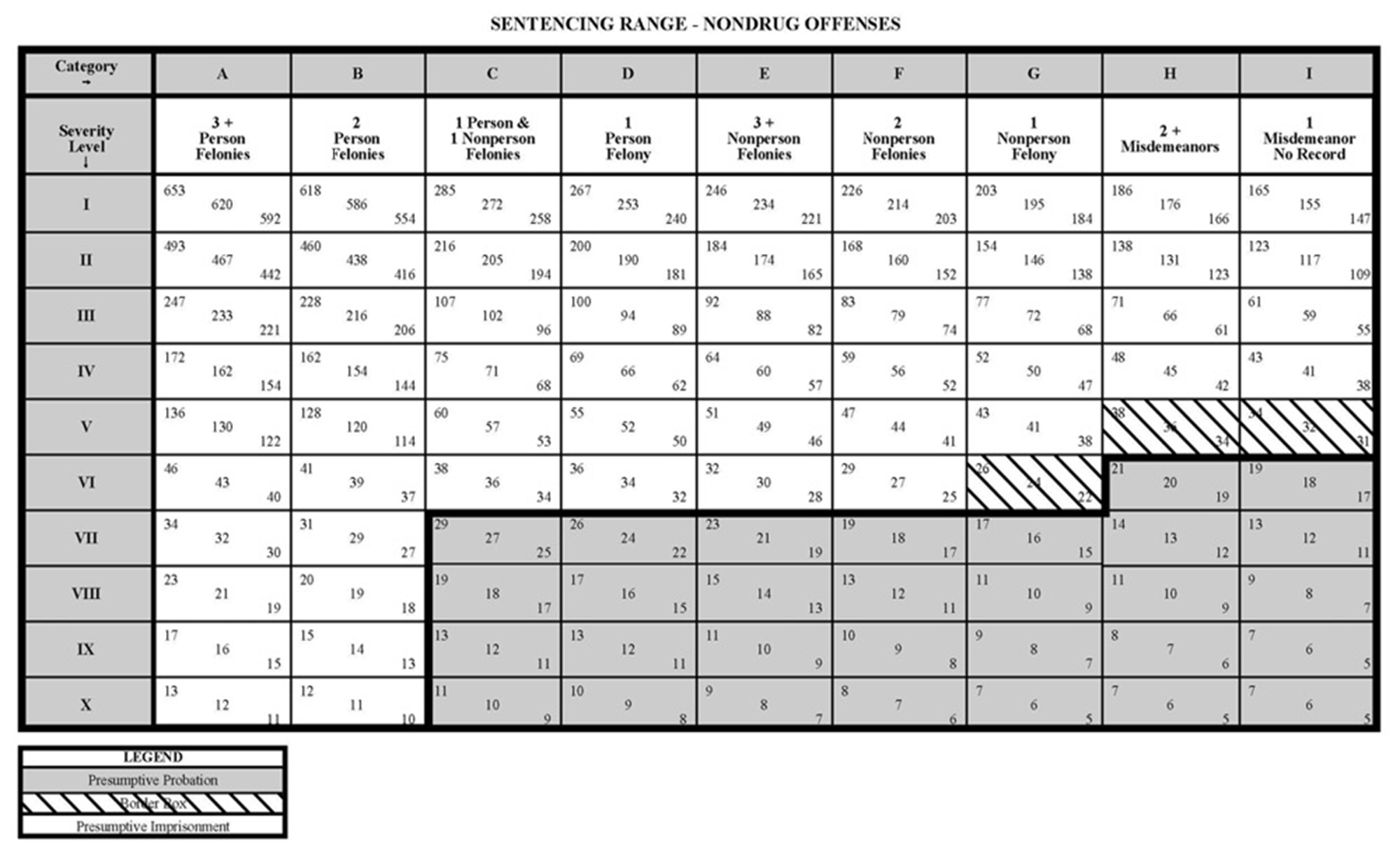
(b) Sentences expressed in the sentencing guidelines grid for nondrug crimes represent months of imprisonment.
(c) The sentencing guidelines grid is a two-dimensional crime severity and criminal history classification tool. The grid’s vertical axis is the crime severity scale which classifies current crimes of conviction. The grid’s horizontal axis is the criminal history scale which classifies criminal histories.
(d) The sentencing guidelines grid for nondrug crimes as provided in this section defines presumptive punishments for felony convictions, subject to the sentencing court’s discretion to enter a departure sentence. The appropriate punishment for a felony conviction should depend on the severity of the crime of conviction when compared to all other crimes and the offender’s criminal history.
(e) (1) The sentencing court has discretion to sentence at any place within the sentencing range. In the usual case it is recommended that the sentencing judge select the center of the range and reserve the upper and lower limits for aggravating and mitigating factors insufficient to warrant a departure.
(2) In presumptive imprisonment cases, the sentencing court shall pronounce the complete sentence which shall include the:
(A) Prison sentence;
(B) maximum potential reduction to such sentence as a result of good time; and
(C) period of postrelease supervision at the sentencing hearing. Failure to pronounce the period of postrelease supervision shall not negate the existence of such period of postrelease supervision.
(3) In presumptive nonprison cases, the sentencing court shall pronounce the:
(A) Prison sentence; and
(B) duration of the nonprison sanction at the sentencing hearing.
(f) Each grid block states the presumptive sentencing range for an offender whose crime of conviction and criminal history place such offender in that grid block. If an offense is classified in a grid block below the dispositional line, the presumptive disposition shall be nonimprisonment. If an offense is classified in a grid block above the dispositional line, the presumptive disposition shall be imprisonment. If an offense is classified in grid blocks 5-H, 5-I or 6-G, the court may impose an optional nonprison sentence as provided in subsection (q).
(g) The sentence for a violation of K.S.A. 21-3415, prior to its repeal, aggravated battery against a law enforcement officer committed prior to July 1, 2006, or a violation of K.S.A. 21-5412(d), and amendments thereto, aggravated assault against a law enforcement officer, which places the defendant’s sentence in grid block 6-H or 6-I shall be presumed imprisonment. The court may impose an optional nonprison sentence as provided in subsection (q).
(h) (1) When a firearm is used to commit any person felony, the offender’s sentence shall be presumed imprisonment. The court may impose an optional nonprison sentence as provided in subsection (q).
(2) When a firearm is used to commit any nonperson felony, the offender’s sentence shall be one severity level above the appropriate level for such offense if the trier of fact makes a finding beyond a reasonable doubt that such firearm was:
(A) Equipped with a device designed to suppress the report of the firearm; or
(B) a shotgun equipped with a forend and having a barrel less than 18 inches in length.
(3) The sentence imposed pursuant to this subsection shall not be considered a departure and shall not be subject to appeal.
(i) (1) The sentence for the violation of the felony provision of K.S.A. 21-5414(c)(1)(C), 21-5823(b)(3) and (b)(4), 21-6412 and 21-6416, and amendments thereto, shall be as provided by the specific mandatory sentencing requirements of that section and shall not be subject to the provisions of this section or K.S.A. 21-6807, and amendments thereto.
(2) If because of the offender’s criminal history classification the offender is subject to presumptive imprisonment or if the judge departs from a presumptive probation sentence and the offender is subject to imprisonment, the provisions of this section and K.S.A. 21-6807, and amendments thereto, shall apply and the offender shall not be subject to the mandatory sentence as provided in K.S.A. 21-5823, and amendments thereto.
(3) Notwithstanding the provisions of any other section, the term of imprisonment imposed for the violation of the felony provision of K.S.A. 21-5414(c)(1)(C), 21-5823(b)(3) and (b)(4), 21-6412 and 21-6416, and amendments thereto, shall not be served in a state facility in the custody of the secretary of corrections. Prior to imposing any sentence pursuant to this subsection, the court may consider assigning the defendant to a house arrest program pursuant to K.S.A. 21-6609, and amendments thereto.
(j) (1) The sentence for any persistent sex offender whose current convicted crime carries a presumptive term of imprisonment shall be double the maximum duration of the presumptive imprisonment term. The sentence for any persistent sex offender whose current conviction carries a presumptive nonprison term shall be presumed imprisonment and shall be double the maximum duration of the presumptive imprisonment term.
(2) Except as otherwise provided in this subsection, as used in this subsection, “persistent sex offender” means a person who:
(A) (i) Has been convicted in this state of a sexually violent crime, as defined in K.S.A. 22-3717, and amendments thereto; and
(ii) at the time of the conviction under clause (i) has at least one conviction for a sexually violent crime, as defined in K.S.A. 22-3717, and amendments thereto, in this state or comparable felony under the laws of another state, the federal government or a foreign government; or
(B) (i) has been convicted of rape, as defined in K.S.A. 21-3502, prior to its repeal, or K.S.A. 21-5503, and amendments thereto; and
(ii) at the time of the conviction under clause (i) has at least one conviction for rape in this state or comparable felony under the laws of another state, the federal government or a foreign government.
(3) Except as provided in subsection (j)(2)(B), the provisions of this subsection shall not apply to any person whose current convicted crime is a severity level 1 or 2 felony.
(k) (1) If it is shown at sentencing that the offender committed any felony violation for the benefit of, at the direction of, or in association with any criminal street gang, with the specific intent to promote, further or assist in any criminal conduct by gang members, the offender’s sentence shall be presumed imprisonment. The court may impose an optional nonprison sentence as provided in subsection (q).
(2) As used in this subsection, “criminal street gang” means any organization, association or group of three or more persons, whether formal or informal, having as one of its primary activities:
(A) The commission of one or more person felonies; or
(B) the commission of felony violations of article 57 of chapter 21 of the Kansas Statutes Annotated, and amendments thereto, K.S.A. 2010 Supp. 21-36a01 through 21-36a17, prior to their transfer, or any felony violation of any provision of the uniform controlled substances act prior to July 1, 2009; and
(C) its members have a common name or common identifying sign or symbol; and
(D) its members, individually or collectively, engage in or have engaged in the commission, attempted commission, conspiracy to commit or solicitation of two or more person felonies or felony violations of article 57 of chapter 21 of the Kansas Statutes Annotated, and amendments thereto, K.S.A. 2010 Supp. 21-36a01 through 21-36a17, prior to their transfer, any felony violation of any provision of the uniform controlled substances act prior to July 1, 2009, or any substantially similar offense from another jurisdiction.
(l) Except as provided in subsection (o), the sentence for a violation of K.S.A. 21-5807(a)(1), and amendments thereto, or any attempt or conspiracy, as defined in K.S.A. 21-5301 and 21-5302, and amendments thereto, to commit such offense, when such person being sentenced has a prior conviction for a violation of K.S.A. 21-3715(a) or (b), prior to its repeal, 21-3716, prior to its repeal, K.S.A. 21-5807(a)(1) or (a)(2) or 21-5807(b), and amendments thereto, or any attempt or conspiracy to commit such offense, shall be presumptive imprisonment.
(m) The sentence for a violation of K.S.A. 22-4903 or K.S.A. 21-5913(a)(2), and amendments thereto, shall be presumptive imprisonment. If an offense under such sections is classified in grid blocks 5-E, 5-F, 5-G, 5-H or 5-I, the court may impose an optional nonprison sentence as provided in subsection (q).
(n) The sentence for a violation of criminal deprivation of property, as defined in K.S.A. 21-5803, and amendments thereto, when such property is a motor vehicle, and when such person being sentenced has any combination of two or more prior convictions of K.S.A. 21-3705(b), prior to its repeal, or of criminal deprivation of property, as defined in K.S.A. 21-5803, and amendments thereto, when such property is a motor vehicle, shall be presumptive imprisonment. Such sentence shall not be considered a departure and shall not be subject to appeal.
(o) (1) The sentence for a felony violation of theft of property as defined in K.S.A. 21-5801, and amendments thereto, or burglary as defined in K.S.A. 21-5807(a), and amendments thereto, when such person being sentenced has no prior convictions for a violation of K.S.A. 21-3701 or 21-3715, prior to their repeal, or theft of property as defined in K.S.A. 21-5801, and amendments thereto, or burglary as defined in K.S.A. 21-5807(a), and amendments thereto; or the sentence for a felony violation of theft of property as defined in K.S.A. 21-5801, and amendments thereto, when such person being sentenced has one or two prior felony convictions for a violation of K.S.A. 21-3701, 21-3715 or 21-3716, prior to their repeal, or theft of property as defined in K.S.A. 21-5801, and amendments thereto, or burglary or aggravated burglary as defined in K.S.A. 21-5807, and amendments thereto; or the sentence for a felony violation of burglary as defined in K.S.A. 21-5807(a), and amendments thereto, when such person being sentenced has one prior felony conviction for a violation of K.S.A. 21-3701, 21-3715 or 21-3716, prior to their repeal, or theft of property as defined in K.S.A. 21-5801, and amendments thereto, or burglary or aggravated burglary as defined in K.S.A. 21-5807, and amendments thereto, shall be the sentence as provided by this section, except that the court may order an optional nonprison sentence for a defendant to participate in a drug treatment program, including, but not limited to, an approved aftercare plan, if the court makes the following findings on the record:
(A) Substance abuse was an underlying factor in the commission of the crime;
(B) substance abuse treatment in the community is likely to be more effective than a prison term in reducing the risk of offender recidivism; and
(C) participation in an intensive substance abuse treatment program will serve community safety interests.
(2) A defendant sentenced to an optional nonprison sentence under this subsection shall be supervised by community correctional services. The provisions of K.S.A. 21-6824(f)(1), and amendments thereto, shall apply to a defendant sentenced under this subsection. The sentence under this subsection shall not be considered a departure and shall not be subject to appeal.
(p) (1) The sentence for a felony violation of theft of property as defined in K.S.A. 21-5801, and amendments thereto, when such person being sentenced has any combination of three or more prior felony convictions for violations of K.S.A. 21-3701, 21-3715 or 21-3716, prior to their repeal, or theft of property as defined in K.S.A. 21-5801, and amendments thereto, or burglary or aggravated burglary as defined in K.S.A. 21-5807, and amendments thereto; or the sentence for a violation of burglary as defined in K.S.A. 21-5807(a), and amendments thereto, when such person being sentenced has any combination of two or more prior convictions for violations of K.S.A. 21-3701, 21-3715 and 21-3716, prior to their repeal, or theft of property as defined in K.S.A. 21-5801, and amendments thereto, or burglary or aggravated burglary as defined in K.S.A. 21-5807, and amendments thereto, shall be presumed imprisonment and the defendant shall be sentenced to prison as provided by this section, except that the court may recommend that an offender be placed in the custody of the secretary of corrections, in a facility designated by the secretary to participate in an intensive substance abuse treatment program, upon making the following findings on the record:
(A) Substance abuse was an underlying factor in the commission of the crime;
(B) substance abuse treatment with a possibility of an early release from imprisonment is likely to be more effective than a prison term in reducing the risk of offender recidivism; and
(C) participation in an intensive substance abuse treatment program with the possibility of an early release from imprisonment will serve community safety interests by promoting offender reformation.
(2) The intensive substance abuse treatment program shall be determined by the secretary of corrections, but shall be for a period of at least four months. Upon the successful completion of such intensive treatment program, the offender shall be returned to the court and the court may modify the sentence by directing that a less severe penalty be imposed in lieu of that originally adjudged within statutory limits. If the offender’s term of imprisonment expires, the offender shall be placed under the applicable period of postrelease supervision. The sentence under this subsection shall not be considered a departure and shall not be subject to appeal.
(q) (1) As used in this section, an “optional nonprison sentence” is a sentence which the court may impose, in lieu of the presumptive sentence, upon making the following findings on the record:
(A) An appropriate treatment program exists which is likely to be more effective than the presumptive prison term in reducing the risk of offender recidivism; and
(B) the recommended treatment program is available and the offender can be admitted to such program within a reasonable period of time; or
(C) the nonprison sanction will serve community safety interests by promoting offender reformation.
(2) Any decision made by the court regarding the imposition of an optional nonprison sentence shall not be considered a departure and shall not be subject to appeal.
(r) The sentence for a violation of K.S.A. 21-5413(c)(2), and amendments thereto, shall be presumptive imprisonment and shall be served consecutively to any other term or terms of imprisonment imposed. Such sentence shall not be considered a departure and shall not be subject to appeal.
(s) The sentence for a violation of K.S.A. 21-5512, and amendments thereto, shall be presumptive imprisonment. Such sentence shall not be considered a departure and shall not be subject to appeal.
(t) (1) If the trier of fact makes a finding beyond a reasonable doubt that an offender wore or used ballistic resistant material in the commission of, or attempt to commit, or flight from any felony, in addition to the sentence imposed pursuant to the Kansas sentencing guidelines act, the offender shall be sentenced to an additional 30 months’ imprisonment.
(2) The sentence imposed pursuant to paragraph (1) shall be presumptive imprisonment and shall be served consecutively to any other term or terms of imprisonment imposed. Such sentence shall not be considered a departure and shall not be subject to appeal.
(3) As used in this subsection, “ballistic resistant material” means any:
(A) Commercially produced material designed with the purpose of providing ballistic and trauma protection, including, but not limited to, bulletproof vests and kevlar vests; and
(B) homemade or fabricated substance or item designed with the purpose of providing ballistic and trauma protection.
(u) The sentence for a violation of K.S.A. 21-6107, and amendments thereto, or any attempt or conspiracy, as defined in K.S.A. 21-5301 and 21-5302, and amendments thereto, to commit such offense, when such person being sentenced has a prior conviction for a violation of K.S.A. 21-4018, prior to its repeal, or K.S.A. 21-6107, and amendments thereto, or any attempt or conspiracy to commit such offense, shall be presumptive imprisonment. Such sentence shall not be considered a departure and shall not be subject to appeal.
(v) The sentence for a third or subsequent violation of K.S.A. 8-1568, and amendments thereto, shall be presumptive imprisonment and shall be served consecutively to any other term or terms of imprisonment imposed. Such sentence shall not be considered a departure and shall not be subject to appeal.
(w) The sentence for aggravated criminal damage to property as defined in K.S.A. 21-5813(b), and amendments thereto, when such person being sentenced has a prior conviction for any nonperson felony shall be presumptive imprisonment. Such sentence shall not be considered a departure and shall not be subject to appeal.
(x) The sentence for a violation of K.S.A. 21-5807(a)(1), and amendments thereto, shall be presumptive imprisonment if the offense under such paragraph is classified in grid blocks 7-C, 7-D or 7-E. Such sentence shall not be considered a departure and shall not be subject to appeal.
(y) (1) Except as provided in paragraph (3), if the trier of fact makes a finding beyond a reasonable doubt that an offender committed a nondrug felony offense, or any attempt or conspiracy, as defined in K.S.A. 21-5301 and 21-5302, and amendments thereto, to commit a nondrug felony offense, against a law enforcement officer, as defined in K.S.A. 21-5111(p)(1) and (3), and amendments thereto, while such officer was engaged in the performance of such officer’s duty, or in whole or in any part because of such officer’s status as a law enforcement officer, the sentence for such offense shall be:
(A) If such offense is classified in severity level 2 through 10, one severity level above the appropriate level for such offense; and
(B) (i) if such offense is classified in severity level 1, except as otherwise provided in clause (ii), imprisonment for life, and such offender shall not be eligible for probation or suspension, modification or reduction of sentence. In addition, such offender shall not be eligible for parole prior to serving 25 years’ imprisonment, and such 25 years’ imprisonment shall not be reduced by the application of good time credits. No other sentence shall be permitted.
(ii) The provisions of clause (i) requiring the court to impose a mandatory minimum term of imprisonment of 25 years shall not apply if the court finds the offender, because of the offender’s criminal history classification, is subject to presumptive imprisonment and the sentencing range exceeds 300 months. In such case, the offender is required to serve a mandatory minimum term equal to the sentence established pursuant to the sentencing range.
(2) The sentence imposed pursuant to paragraph (1) shall not be considered a departure and shall not be subject to appeal.
(3) The provisions of this subsection shall not apply to an offense described in paragraph (1) if the factual aspect concerning a law enforcement officer is a statutory element of such offense.
(z) (1) Notwithstanding K.S.A. 21-5109(b)(2), and amendments thereto, or any other provision of law to the contrary, the sentence for a violation of criminal possession of a weapon by a convicted felon as defined in K.S.A. 21-6304, and amendments thereto, shall be presumptive imprisonment and shall be served consecutively to any other term or terms of imprisonment imposed if the trier of fact makes a finding beyond a reasonable doubt that:
(A) The weapon the offender possessed during such violation was a firearm; and
(B) such firearm was used by the offender during the commission of any violent felony.
(2) The sentence imposed pursuant to paragraph (1) shall not be considered a departure and shall not be subject to appeal. No other sentence shall be permitted.
(3) The provisions of this subsection shall not apply to an offender who is prohibited from possessing a weapon pursuant to K.S.A. 21-6304, and amendments thereto, as a result of a juvenile adjudication.
(4) As used in this subsection, “violent felony” means any of the following:
(A) Capital murder, as defined in K.S.A. 21-5401, and amendments thereto;
(B) murder in the first degree, as defined in K.S.A. 21-5402, and amendments thereto;
(C) murder in the second degree, as defined in K.S.A. 21-5403, and amendments thereto;
(D) voluntary manslaughter, as defined in K.S.A. 21-5404, and amendments thereto;
(E) kidnapping, as defined in K.S.A. 21-5408(a)(1), and amendments thereto, or aggravated kidnapping, as defined in K.S.A. 21-5408(b), and amendments thereto;
(F) aggravated assault, as defined in K.S.A. 21-5412(b)(1), and amendments thereto, and aggravated assault of a law enforcement officer, as defined in K.S.A. 21-5412(d)(1), and amendments thereto;
(G) aggravated battery, as defined in K.S.A. 21-5413(b)(1)(A) or (b)(1)(B), and amendments thereto, and aggravated battery against a law enforcement officer, as defined in K.S.A. 21-5413(d)(1) or (d)(2), and amendments thereto;
(H) mistreatment of a dependent adult or mistreatment of an elder person, as defined in K.S.A. 21-5417(a)(1), and amendments thereto;
(I) rape, as defined in K.S.A. 21-5503, and amendments thereto;
(J) aggravated criminal sodomy, as defined in K.S.A. 21-5504(b), and amendments thereto;
(K) abuse of a child, as defined in K.S.A. 21-5602(a)(1) or (a)(3), and amendments thereto;
(L) any felony offense described in K.S.A. 21-5703 or 21-5705, and amendments thereto;
(M) treason, as defined in K.S.A. 21-5901, and amendments thereto;
(N) criminal discharge of a firearm, as defined in K.S.A. 21-6308(a)(1), and amendments thereto;
(O) fleeing or attempting to elude a police officer, as defined in K.S.A. 8-1568(b), and amendments thereto;
(P) any felony that includes the domestic violence designation pursuant to K.S.A. 22-4616, and amendments thereto; or
(Q) any attempt, conspiracy or criminal solicitation, as defined in K.S.A. 21-5301, 21-5302 and 21-5303, and amendments thereto, of any felony offense defined in this subsection.
(aa) (1) The sentence for a violation of K.S.A. 21-6308(a)(1)(A) or (a)(1)(B), and amendments thereto, if the trier of fact makes a finding beyond a reasonable doubt that the offender discharged a firearm and that the offender knew or reasonably should have known that:
(A) A person was present in the dwelling, building, structure or motor vehicle at which the offender discharged a firearm, shall be presumptive imprisonment and, in addition to the sentence imposed pursuant to the Kansas sentencing guidelines act, the offender shall be sentenced to an additional 60 months of imprisonment; and
(B) a person less than 14 years of age was present in the dwelling, building, structure or motor vehicle at which the offender discharged a firearm, shall be presumptive imprisonment and, in addition to the sentence imposed pursuant to the Kansas sentencing guidelines act, the offender shall be sentenced to an additional 120 months of imprisonment.
(2) The sentence imposed pursuant to paragraph (1) shall be served consecutively to any other term or terms of imprisonment imposed. Such sentence shall not be considered a departure and shall not be subject to appeal.
(bb) (1) If the trier of fact makes a finding beyond a reasonable doubt that an offender committed any act described in K.S.A. 21-5408, 21-5409, 21-5411, 21-5412, 21-5413, 21-5414, 21-5415, 21-5426, 21-5427, 21-5428, 21-5429, 21-5503, 21-5504, 21-5505, 21-5506, 21-5507, 21-5508, 21-5509, 21-5510, 21-5515, 21-5601, 21-5602, 21-5604 or 21-5605, and amendments thereto, or any attempt or conspiracy, as defined in K.S.A. 21-5301 and 21-5302, and amendments thereto, to commit any such act with knowledge that a woman is pregnant and with the intent that such act will compel such woman to obtain an abortion when such woman has expressed her desire to not obtain an abortion, the sentence for such offense shall be:
(A) If such offense is classified in severity level 2 through 10, one severity level above the appropriate level for such offense; and
(B) (i) if such offense is classified in severity level 1, except as otherwise provided in clause (ii), imprisonment for life, and such offender shall not be eligible for probation or suspension, modification or reduction of sentence. In addition, such offender shall not be eligible for parole prior to serving 25 years’ imprisonment, and such 25 years’ imprisonment shall not be reduced by the application of good time credits. No other sentence shall be permitted.
(ii) The provisions of clause (i) requiring the court to impose a mandatory minimum term of imprisonment of 25 years shall not apply if the court finds the offender, because of the offender’s criminal history classification, is subject to presumptive imprisonment and the sentencing range exceeds 300 months. In such case, the offender is required to serve a mandatory minimum term equal to the sentence established pursuant to the sentencing range.
(2) The sentence imposed pursuant to paragraph (1) shall not be considered a departure and shall not be subject to appeal.
Sec. 5. K.S.A. 2025 Supp. 21-6805 is hereby amended to read as follows: 21-6805. (a) The provisions of this section shall be applicable to the sentencing guidelines grid for drug crimes. The following sentencing guidelines grid for drug crimes shall be applicable to felony crimes under K.S.A. 21-5701 through 21-5717, and amendments thereto, except as otherwise provided by law:
(b) Sentences expressed in the sentencing guidelines grid for drug crimes in subsection (a) represent months of imprisonment.
(c) (1) The sentencing court has discretion to sentence at any place within the sentencing range. In the usual case it is recommended that the sentencing judge select the center of the range and reserve the upper and lower limits for aggravating and mitigating factors insufficient to warrant a departure. The sentencing court shall not distinguish between the controlled substances cocaine base (9041L000) and cocaine hydrochloride (9041L005) when sentencing within the sentencing range of the grid block.
(2) In presumptive imprisonment cases, the sentencing court shall pronounce the complete sentence which shall include the:
(A) Prison sentence;
(B) maximum potential reduction to such sentence as a result of good time; and
(C) period of postrelease supervision at the sentencing hearing. Failure to pronounce the period of postrelease supervision shall not negate the existence of such period of postrelease supervision.
(3) In presumptive nonprison cases, the sentencing court shall pronounce the prison sentence as well as the duration of the nonprison sanction at the sentencing hearing.
(d) Each grid block states the presumptive sentencing range for an offender whose crime of conviction and criminal history place such offender in that grid block. If an offense is classified in a grid block below the dispositional line, the presumptive disposition shall be nonimprisonment. If an offense is classified in a grid block above the dispositional line, the presumptive disposition shall be imprisonment. If an offense is classified in grid blocks 4-E, 4-F, 4-G, 4-H, 4-I, 5-C or 5-D, the court may impose an optional nonprison sentence as provided in K.S.A. 21-6804(q), and amendments thereto.
(e) The sentence for a second or subsequent conviction for unlawful manufacturing of a controlled substance, K.S.A. 65-4159, prior to its repeal, K.S.A. 2010 Supp. 21-36a03, prior to its transfer, K.S.A. 21-5703, and amendments thereto, or a substantially similar offense from another jurisdiction, if the controlled substance in any prior conviction was methamphetamine, as defined by K.S.A. 65-4107(d)(3) or (f)(1), and amendments thereto, or an analog thereof, shall be a presumptive term of imprisonment of two times the maximum duration of the presumptive term of imprisonment. The court may impose an optional reduction in such sentence of not to exceed 50% of the mandatory increase provided by this subsection upon making a finding on the record that one or more of the mitigating factors as specified in K.S.A. 21-6815, and amendments thereto, justify such a reduction in sentence. Any decision made by the court regarding the reduction in such sentence shall not be considered a departure and shall not be subject to appeal.
(f) (1) The sentence for a third or subsequent felony conviction of K.S.A. 65-4160 or 65-4162, prior to their repeal, K.S.A. 2010 Supp. 21-36a06, prior to its transfer, or K.S.A. 21-5706, and amendments thereto, shall be a presumptive term of imprisonment and the defendant shall be sentenced to prison as provided by this section. The defendant’s term of imprisonment shall be served in the custody of the secretary of corrections in a facility designated by the secretary. Subject to appropriations therefore, the defendant shall participate in an intensive substance abuse treatment program, of at least four months duration, selected by the secretary of corrections. If the secretary determines that substance abuse treatment resources are otherwise available, such term of imprisonment may be served in a facility designated by the secretary of corrections in the custody of the secretary of corrections to participate in an intensive substance abuse treatment program. The secretary’s determination regarding the availability of treatment resources shall not be subject to review. Upon the successful completion of such intensive treatment program, the offender shall be returned to the court and the court may modify the sentence by directing that a less severe penalty be imposed in lieu of that originally adjudged. If the offender’s term of imprisonment expires, the offender shall be placed under the applicable period of postrelease supervision.
(2) Such defendant’s term of imprisonment shall not be subject to modification under paragraph (1) if:
(A) The defendant has previously completed a certified drug abuse treatment program, as provided in K.S.A. 75-52,144, and amendments thereto;
(B) has been discharged or refused to participate in a certified drug abuse treatment program, as provided in K.S.A. 75-52,144, and amendments thereto;
(C) has completed an intensive substance abuse treatment program under paragraph (1); or
(D) has been discharged or refused to participate in an intensive substance abuse treatment program under paragraph (1).
(3) The sentence under this subsection shall not be considered a departure and shall not be subject to appeal.
(g) (1) Except as provided further, if the trier of fact makes a finding that an offender carried a firearm to commit a drug felony, or in furtherance of a drug felony, possessed a firearm, in addition to the sentence imposed pursuant to K.S.A. 21-6801 through 21-6824, and amendments thereto, the offender shall be sentenced to:
(A) Except as provided in subsection (g)(1)(B), an additional 6 months’ imprisonment; and
(B) if the trier of fact makes a finding that the firearm was discharged, an additional 18 months’ imprisonment.
(2) When a firearm is used to commit any drug felony that is not subject to the provisions of subsection (g)(1), the offender’s sentence shall be one severity level above the appropriate level for such offense if the trier of fact makes a finding beyond a reasonable doubt that such firearm was:
(A) Equipped with a device designed to suppress the report of the firearm; or
(B) a shotgun equipped with a forend and having a barrel less than 18 inches in length.
(3) The sentence imposed pursuant to this subsection (g)(1) shall be presumptive imprisonment. Such sentence shall not be considered a departure and shall not be subject to appeal.
(3)(4) The provisions of this subsection (g)(1) shall not apply to violations of K.S.A. 21-5706 or 21-5713, and amendments thereto.
(h) (1) The sentence for a violation of the following with respect to material containing any quantity of a fentanyl-related controlled substance shall be presumed imprisonment and shall be two times the maximum duration of the presumptive term of imprisonment:
(A) K.S.A. 21-5703, and amendments thereto; and
(B) K.S.A. 21-5705, and amendments thereto, if the violation is classified as a drug severity level 1, 2 or 3 felony.
(2) Such sentence shall not be considered a departure and shall not be subject to appeal.
(i) The sentence for a violation of K.S.A. 21-5703 or 21-5705, and amendments thereto, shall be presumed imprisonment and shall be two times the maximum duration of the presumptive term of imprisonment if the trier of fact makes a finding beyond a reasonable doubt that the controlled substance involved, because of its appearance or packaging, was likely to be attractive to minors. Such sentence shall not be considered a departure and shall not be subject to appeal.
Sec. 6. K.S.A. 21-6301 and 21-6302 and K.S.A. 2025 Supp. 21-6804 and 21-6805 are hereby repealed.
Sec. 7. This act shall take effect and be in force from and after its publication in the statute book.
Approved April 9, 2026.